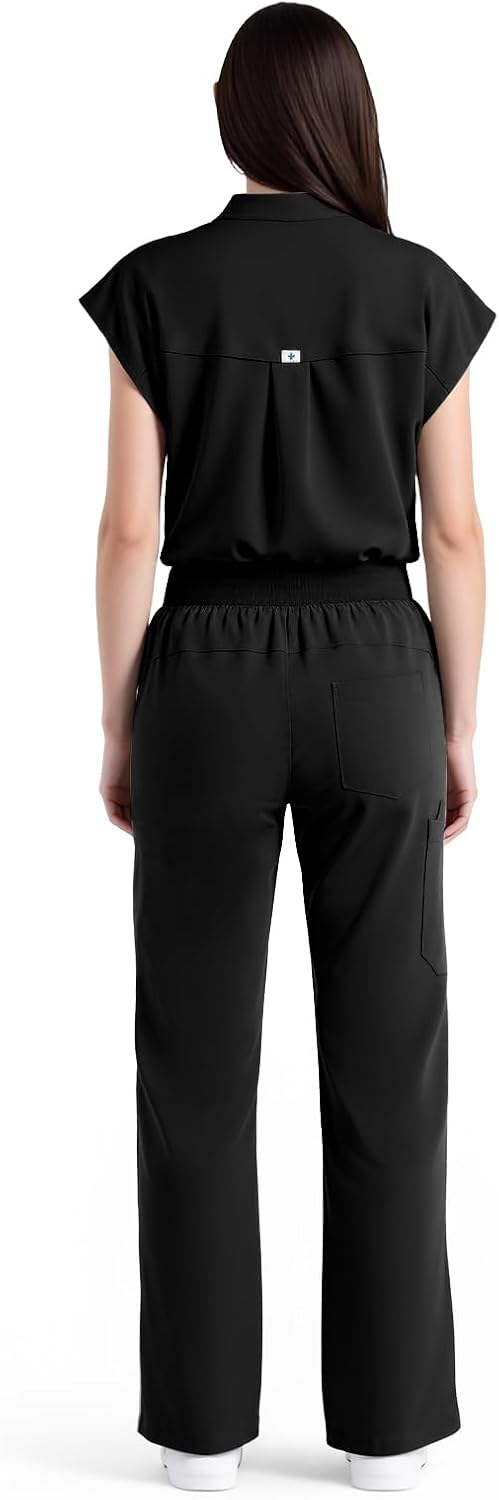
If you work in a unit where the thermostat feels permanently set to “aggressive,” you already know the calculation: every extra layer of fabric is a tax on your energy by hour six. A sleeveless scrub top is exactly what the name says — a scrub top (the shirt-style uniform worn by nurses and other clinical staff) cut without sleeves, designed to keep you cooler during long shifts in warm environments. Labor and delivery suites, neonatal intensive care units (NICUs), burn units, and some fast-paced procedural settings often run warmer than a typical medical floor, and in those spaces the difference between a capped sleeve and a full sleeve can be the difference between manageable and miserable. This guide is for nurses who are already past the “what even is a scrub” stage and are now making a real purchasing decision — or advocating to their manager about what the team should wear. We’ll cover which styles actually work, what your hospital’s dress code realistically permits, and how to build a layering system that keeps you both comfortable and compliant.
| EDITOR'S PICKScrubs for Women Set Soft Sleev… | Mid-tierScrubs for Women Set | Budget pickScrubs for Women Set | |
|---|---|---|---|
| Pockets | 9 | 8 | 8 |
| Collar type | Stand-up | Stand | Stand-up |
| Pant type | Straight leg | Jogger | Jogger |
| Waistband | Yoga | Drawstring | — |
| Badge loop | — | ✓ | — |
| Material | — | Soft stretch | — |
| Price | $31.99 | $26.98 | $12.99 |
| See on Amazon → | See on Amazon → | See on Amazon → |
Why Warm Units Create a Real Dress-Code Tension
The warmth problem isn’t just about comfort — it’s clinical. Research cited in the American Nurses Association’s “Dress Code and Appearance in Nursing Practice” position statement acknowledges that thermal discomfort affects concentration and physical endurance, particularly during extended shifts. At the same time, bare skin creates its own set of concerns that dress codes are specifically designed to address.
The central tension is this: most hospital dress codes were written with infection control and professionalism as the primary frames, not thermoregulation. That means the baseline assumption in most policy documents is a short-sleeve or long-sleeve top with a defined cuff. Sleeveless styles exist in a gray zone — they’re not universally banned, but they’re rarely explicitly approved either.
Here’s where it gets practical. The Association for Professionals in Infection Control and Epidemiology (APIC), in its “Infection Control and Prevention for Healthcare Personnel Attire” guidance document, draws a distinction between bare forearms (which have been debated as a surface for pathogen transfer) and bare upper arms, which carry far less evidence-based concern. The “bare below the elbows” movement in the UK essentially codified the forearm argument — but that same rationale does not extend to upper arms. A sleeveless top that covers your torso and keeps your forearms free is actually consistent with the spirit of bare-below-the-elbows guidance, even if your hospital hasn’t made that logic explicit in its written policy.
The Joint Commission’s 2025 Environment of Care and Infection Prevention Standards do not categorically prohibit sleeveless clinical attire. What they do require is that facilities have a documented dress-code policy and that staff follow it. That means the door is open — but your unit’s specific policy document is what governs you, not general guidelines.
Before you buy anything: pull up your hospital’s dress code. If it says “short sleeve minimum,” you’re looking at underlayers. If it’s silent on sleeves, you likely have more room than you think, and a conversation with your charge nurse or nurse manager can confirm it.
What “Sleeveless” Actually Means in Scrub Design
Not all sleeveless tops are built the same way, and the distinction matters for both compliance and coverage.
Racerback style — the back straps meet in a V or Y between the shoulder blades — is the most athletic-looking cut. It tends to be the most ventilated, but it’s also the style most likely to raise an eyebrow in conservative dress-code environments. The shoulder coverage is narrower, and the back panel can feel more “gym” than “clinical” depending on the fabric weight.
Wide-strap tank style — straps are two to three inches wide, more like a fitted tank top than a racerback — reads as more professional and is easier to pair with a scrub jacket or zip-up layer without the back straps creating bulk.
Cap-sleeve-adjacent sleeveless — some manufacturers describe very short cap sleeves as “sleeveless” in their marketing. If a top shows any sleeve definition at all, even a half-inch band, it tends to satisfy more dress-code reviewers than a true tank.
V-neck vs. round neck: V-neck styling tends to photograph and present as more professional in clinical settings. Round-neck styles in scrub fabric can slide toward “gym wear” in appearance, which is worth considering if you’re in a patient-facing role where appearance standards are enforced more strictly.
By the Numbers
| Style | Typical shoulder coverage | Dress-code risk level | Best use case |
|---|---|---|---|
| Racerback scrub tank | Narrow (1–1.5 in. strap) | Moderate–High | Under a jacket; break room layer |
| Wide-strap scrub tank | Moderate (2.5–3 in. strap) | Low–Moderate | Solo wear in permissive units |
| Short cap-sleeve “sleeveless” | Full shoulder + short cap | Low | Most dress-code environments |
| Sleeveless scrub tunic (longer hem) | Moderate to full | Low | Charge nurses, clinical supervisors |
Fabric and Fit: Where the Real Performance Difference Lives
The reason to pay attention to fabric in a sleeveless top is slightly different from a standard scrub top. Without sleeves, the top’s torso fabric does all of the moisture-management work. A fabric that pills or holds sweat isn’t just uncomfortable — it becomes visually obvious faster on a sleeveless style because there’s more exposed surface area.
Performance stretch blends (typically polyester-spandex or nylon-spandex, often labeled “4-way stretch”) are the dominant category in sleeveless scrub tops from mid-range and premium brands. Owners of scrubs in this category consistently report that moisture-wicking finishes make a measurable difference in warm units, pulling sweat away from skin rather than absorbing it into the fabric. Brands like FIGS, Jaanuu, and Mandala Scrubs all offer sleeveless or near-sleeveless styles in their performance fabric lines. Published spec sheets for these lines typically describe the fabric as antimicrobial-finished and rated for 50+ washes before the wicking treatment degrades — a claim that aggregated long-term reviews broadly support, with some owners noting the finish begins to diminish around the 40-wash mark with hot-water washing.
100% cotton or cotton-blend scrub tanks exist at the value tier (Cherokee Workwear produces some), and they’re softer against skin — but owners consistently flag that they absorb moisture rather than move it, which defeats the purpose in a warm unit. If you’re going sleeveless specifically to manage heat, cotton is a trade-down.
Pocket depth is often sacrificed in sleeveless styles to keep the silhouette clean. Most sleeveless scrub tops offer one or two front pockets at best, and side pockets are rare. If you carry a trauma shear, penlight, and phone routinely, plan on pairing your sleeveless top with scrub pants that have deep cargo pockets or a clinical utility belt — or use a sleeveless style only on lower-carrying shifts.
Good Housekeeping’s 2024 performance fabric overview notes that fabrics labeled “moisture-wicking” vary significantly in actual performance depending on the weave tightness and finish application method — looser weaves wick faster but also pill faster. That’s worth knowing when comparing a $22 budget option against a $65 mid-range top: the difference isn’t just branding.
Building a Layering System That Actually Works
Here’s the practical decision most warm-unit nurses land on: a sleeveless scrub top worn under a lightweight scrub jacket or zip-up warm-up jacket, with the outer layer removed during the hottest parts of the shift.
This approach solves the dress-code problem elegantly. Most hospital policies that require sleeve coverage are satisfied the moment you have a sleeved layer in play, even if you’re removing it at the nurses’ station. It also gives you a hygiene argument: a clean scrub jacket that you pull off before direct patient contact and replace after is, in many interpretations, more consistent with infection-control principles than a long-sleeve top you never change.
OSHA’s “Personal Protective Equipment in Healthcare Settings” general industry guidance draws a clear line between dress-code attire (the hospital’s jurisdiction) and PPE like gowns and gloves (federally regulated). Your sleeveless scrub top is attire, not PPE — which means the compliance question lives entirely within your facility’s dress-code policy, and that policy can be updated by unit managers and nursing leadership without regulatory friction.
A layering system worth building around at the mid-to-premium tier:
- Sleeveless top: Jaanuu wide-strap tank or FIGS sleeveless shell in performance stretch fabric → [PRODUCT: mid-range sleeveless scrub top]
- Outer layer: A lightweight scrub zip-up jacket (Barco or Grey’s Anatomy warm-up jacket lines are consistent performers based on owner reviews) → [PRODUCT: lightweight scrub warm-up jacket]
- Compression socks: Non-negotiable in any warm unit — Sigvaris 412 or Therafirm Core-Spun for a graduated compression system that doesn’t add core body heat → [PRODUCT: graduated compression socks for nurses]
The Decision Rule
If you’ve read this far and are still deciding whether to buy, here’s the framework:
If your dress code explicitly permits sleeveless or is silent on it, and your unit runs consistently above 72°F: a wide-strap performance scrub tank paired with a lightweight jacket you can remove is the cleanest solution. Spend at the mid-range ($35–$65 range for the top) to get real moisture-wicking performance — the cheap-end options will disappoint you by month two.
If your dress code requires short-sleeve minimum: look at cap-sleeve styles marketed as “sleeveless” — the half-inch cap satisfies most policy reviewers, and you retain most of the ventilation benefit. Alternatively, advocate directly to your manager using the APIC bare-below-the-elbows framework as a reference point. That conversation has a real chance of updating your unit policy, especially if you’re charge-level or above.
If you’re in a specialty where bare skin is a contact-contamination concern (burn unit, transplant, immunocompromised patient populations): the answer is no on solo sleeveless wear, and the APIC guidance supports that position. A cooling underlayer worn under a standard short-sleeve scrub top is a better engineering solve than going sleeveless.
If you’re buying for a team or building a unit standard: default to wide-strap tank + scrub jacket as the approved combination, document it explicitly in your unit’s dress-code addendum, and you’ll satisfy both comfort needs and compliance reviewers without ongoing friction.
The bottom line is that sleeveless scrubs are a legitimate clinical choice in the right context — not a workaround, not a compromise, and not inherently unprofessional. The dress-code landscape has enough flexibility that most nurses in warm units can get there with the right framing and the right style. Know your policy, choose your fabric deliberately, and build the layering system before you need it in July.