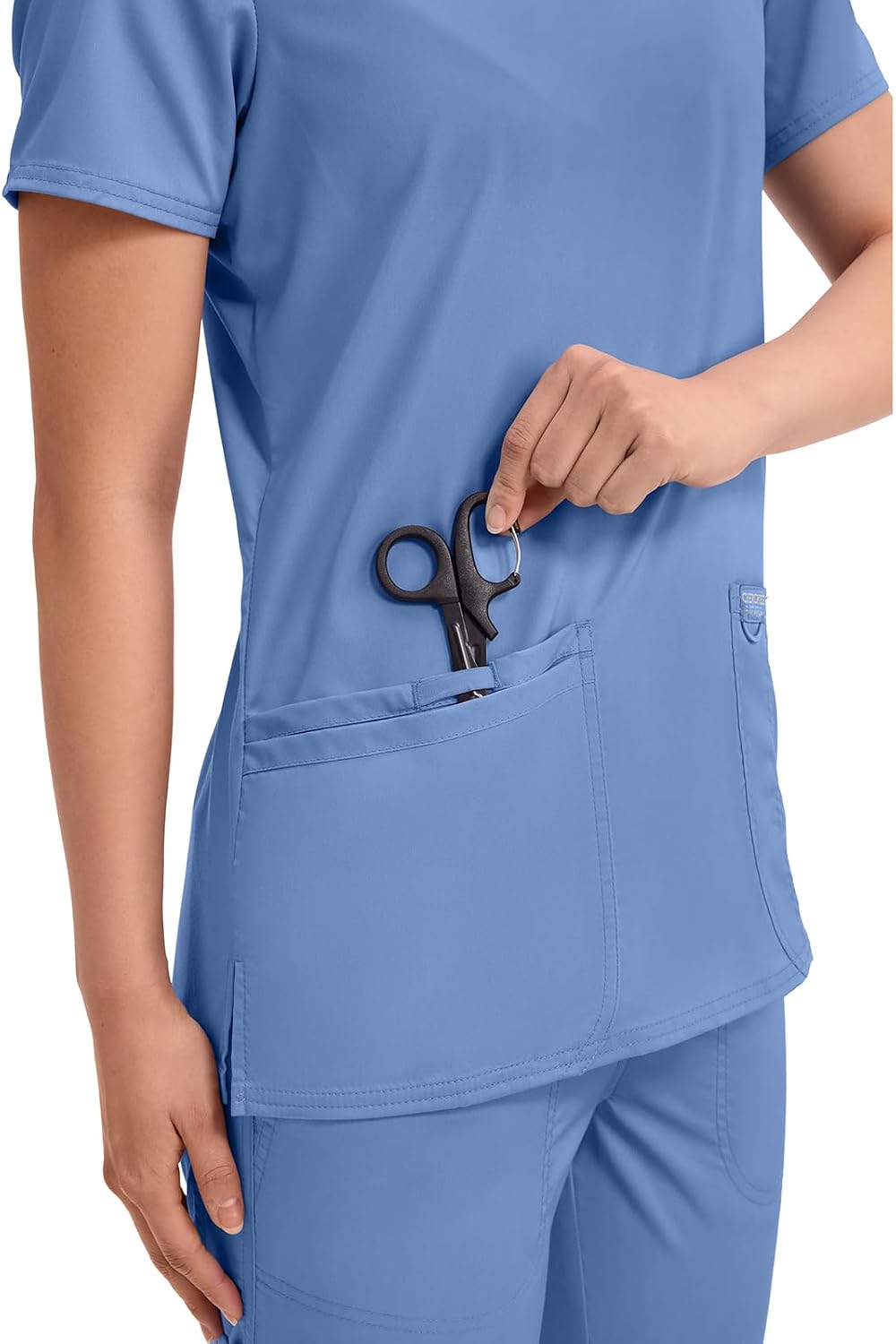
A scrub top is the garment you put on before a 12-hour shift and take off — usually exhausted — at the end of one. Unlike a blazer or a dress shirt, it has to survive repeated industrial laundering (wash cycles run hotter and more aggressively than home machines), exposure to bodily fluids, constant movement, and the quiet indignity of being stretched sideways every time you reach across a bed. “Scrubs” is the shorthand for the loose, clinical-wear uniforms worn by nurses and other healthcare workers; the top half is where most of the functional decisions live — pockets, fabric blend, and fit. If you are 6 to 24 months into your nursing career, you have probably already replaced at least one cheap top that pilled, shrunk, or fell apart at the hem. This guide is about making the next purchase count: we will walk through the fabric blends that actually hold up, what pocket depth means in practice, and how to match both to your unit’s physical demands. No brand loyalty assumed; just the specs and what owners consistently report about them.
| EDITOR'S PICK[COZYFIT Scrubs for Women - Mock…](https://www.amazon.com/dp/B0DRG74BMC?tag=greenflower20-20) | Mid-tier[Cherokee Women's Medical Scrub…](https://www.amazon.com/dp/B078J4D8XY?tag=greenflower20-20) | Budget pick[Hanes Women's Scrubs Healthcare…](https://www.amazon.com/dp/B0DKG7BWGG?tag=greenflower20-20) | |
|---|---|---|---|
| Fabric Type | Soft fabric | Knit | Stretch |
| Pocket Count | 6 | — | — |
| Moisture Wicking | — | — | ✓ |
| Closure Style | Mock wrap | V-neck | — |
| Side Panels | — | — | ✓ |
| Seam Detail | Princess seams | — | — |
| Price | $35.99 | $26.27 | $15.29 |
| See on Amazon → | See on Amazon → | See on Amazon → |
Why Fabric Blend Is the First Decision, Not the Last
Most nurses shop scrub tops by color or price and end up learning about fabric the hard way — after three months of washing. Let’s short-circuit that.
The dominant blends on the market right now fall into four categories, and each involves a real tradeoff.
100% Cotton was the standard in nursing for decades. It breathes well and feels soft against skin during a long shift. The catch is laundering behavior: published textile research cited in Textile World’s 2023 overview of healthcare apparel fabrics notes that untreated 100% cotton can shrink 5–8% after the first industrial wash cycle and continues to lose shape over time. For nurses whose facilities use commercial laundry services (common in hospital systems), this is a meaningful durability problem. Cotton also wrinkles badly and does not wick moisture, which matters if your unit runs warm or your shift involves physical transfers.
Polyester-cotton blends (typically 55/45 or 65/35 poly/cotton) are the workhorse of mid-range scrubs. The polyester component resists shrinkage and holds color through repeated washing; the cotton keeps the fabric from feeling entirely synthetic against skin. Reviewers across aggregated review sets consistently rate this blend as the most low-maintenance for everyday floor nursing. The downside: at lower thread counts or in budget-tier construction, polyester-heavy blends can pill along friction points — the hem where your badge holder rubs, the underarm, the pocket edges — within 60–90 days of regular use. This is the category where construction quality (seam finishing, fabric weight) varies most dramatically between a $15 Cherokee top and a $65 FIGS Rafaela.
Rayon or modal blends show up frequently in premium scrub lines positioned at the $80–$120 tier. Rayon is a semi-synthetic fiber derived from wood pulp; modal is a specific type of rayon processed for softer hand-feel and better color retention. Owners of Jaanuu scrubs (which use a proprietary modal-polyester blend) consistently describe them as noticeably softer and more flattering in silhouette than standard poly-cotton. The tradeoff is care sensitivity: modal does not tolerate high-heat drying as well as poly-cotton, and institutional laundering can shorten its lifespan. If your facility dry-cleans or machines-washes scrubs for you, check whether modal blends are compatible with their process before investing.
Four-way stretch fabrics — typically a poly-spandex or nylon-spandex blend with 2–5% elastane — have moved from athleisure into nursing workwear meaningfully over the past three years. The American Nurses Association’s 2024 Healthy Nurse Healthy Nation Workplace Environment Survey identified musculoskeletal strain as one of the top physical concerns reported by floor nurses. Stretch fabrics directly reduce resistance during lateral and overhead movements, which matters on units with heavy patient-repositioning loads (ICU, med-surg, ortho). Published specs on stretch-forward scrub lines like the FIGS Rafaela and Mandala Scrubs put elastane content at 3–5% — enough to provide range-of-motion benefit without the durability loss that comes from higher spandex percentages.
Pocket Depth: What the Spec Sheet Doesn’t Tell You
“Deep pockets” appears in virtually every scrub top marketing description, which has made the phrase nearly meaningless. Here is what actually matters, translated into working terms.
Functional pocket depth is the distance from the pocket opening to the bottom seam, measured when the pocket is flat against the body. A pocket that measures 6 inches deep on a spec sheet may effectively be 4.5 inches deep when the fabric is stretched against a body in motion, because the side seams pull the pocket walls inward. Owners of budget-tier scrub tops on long-run review threads frequently cite this as the reason pens, trauma shears, and folded note cards work their way out during a shift.
What actually fits: A standard trauma shear (bandage scissors) is approximately 7.5 inches long. A loaded retractable pen is 5.5–6 inches. A folded 4×6 nursing brain sheet (a personal reference card many floor nurses carry) requires at least 5 inches of usable depth. By those numbers, a pocket that advertises 7–8 inches of depth with a reinforced bottom seam is the functional minimum for carrying both shears and a pen without stacking them at awkward angles.
Chest pockets vs. lower front pockets: Most scrub tops include one chest pocket and two or three lower front pockets. The chest pocket is useful for pens and a penlight but is functionally too shallow (typically 4–5 inches) for anything larger. The lower front pockets carry the load, and their positioning relative to the hip seam matters: pockets set too low ride on the thigh during sitting and dump contents when you lean forward; pockets set at natural hip height stay put through repositioning and charting. Wirecutter’s updated 2025 scrub review notes that pocket placement is one of the most subjective but consistently cited factors in long-term owner satisfaction.
Pocket count by specialty context:
| Unit Type | Minimum Useful Pockets | Why |
|---|---|---|
| ICU / Critical Care | 4+ (including 1 chest) | Multiple medications, note cards, assessment tools |
| Med-Surg / Float Pool | 3–4 | Variable patient load, frequent repositioning |
| Psych / Behavioral Health | 2–3, no external clips | Ligature risk means minimizing protrusions |
| Outpatient / Clinic | 2–3 | Lower physical demand, professional appearance priority |
Psych nurses are the category most underserved by standard scrub top design: the same deep-pocket, clip-heavy construction that works brilliantly in an ICU creates real safety concerns in a behavioral health setting. Good Housekeeping’s 2025 scrub roundup specifically flags this, recommending streamlined, minimal-hardware tops for psych and calling out the ligature risk created by badge reels, pen clips, and dangling pocket dividers.
The Price-Tier Reality Check
Here is where the math gets honest.
Entry-level ($15–$25/top): Cherokee Workwear remains the volume leader in this category. Published specs put the primary fabric blend at a 55/45 poly-cotton. Owners consistently report adequate durability for the price point — most get 12–18 months of regular use before noticeable pilling — but note that pocket depth and seam finishing are where Cherokee cuts costs. For nursing students doing clinicals or nurses in facilities with high laundry-damage rates, this is a rational choice. The cost-per-wear math simply does not justify a $90 top if your facility’s commercial laundering destroys scrubs in 6 months.
Mid-range ($55–$80/top): FIGS Rafaela and similar tailored-fit tops in this tier use higher elastane percentages and finer fabric construction. Owners who have worn both entry-level and mid-range tops over a career arc consistently report that mid-range tops hold color and shape significantly longer — 2–3 years of regular washing versus 12–18 months for budget-tier. The pocket construction is more substantial, with reinforced bottom seams and wider pocket openings. If you are past your first year and working the same unit consistently, this is where the per-wear cost math starts to favor the investment.
Premium ($90–$120+/top): Jaanuu’s tailored sets and Medelita’s fitted tops are positioning for a different buyer: nurses for whom professional appearance is part of clinical identity, particularly in leadership, advanced practice, or outward-facing roles (charge nurse, NP, educator). The modal-forward fabrics in this tier feel meaningfully different against skin and drape better — reviewers consistently note the difference in how these tops wear at hour 10 versus hour 2. The tradeoff is care requirements and per-unit cost. For travel nurses building a per-assignment kit on a tight budget, premium tops are harder to justify. For a charge RN five years in who wears the same three tops on rotation, one $110 top that lasts three years outperforms three $35 tops replaced annually.
If X, Then Y: The Decision Rule
After going through the specs and the aggregated owner feedback, here is the framework that holds up across buyer types.
If you are a nursing student or new grad in your first unit assignment: Start with Cherokee or a comparable 55/45 poly-cotton blend at the $15–$25 price point. Buy three to four tops to cover a full week. Prioritize pocket count over fabric softness. Assess your facility’s laundry conditions before upgrading.
If you are 12–24 months in, on a consistent unit, and replacing worn-out tops: Step up to the mid-range tier. FIGS Rafaela or a comparable four-way stretch top in the $55–$75 range will outlast two rounds of budget replacements and will hold up better to the specific physical demands of your unit. If you are on ICU or med-surg with heavy patient contact, prioritize stretch content and deep lower pockets. If you are in psych, prioritize minimal hardware and shallow chest construction.
If you are a seasoned floor nurse, charge nurse, or advanced-practice clinician investing in a professional wardrobe: The premium modal-blend tier earns its price point in comfort, appearance, and longevity — but only if you control your own laundry. If your facility runs commercial laundry services, confirm that modal and stretch blends are compatible before committing $100+ per top.
If you are building a float pool or travel-nurse kit: Durability over luxury. Three or four mid-range poly-cotton tops that survive variable facility laundry conditions will serve a travel assignment better than premium fabric that requires careful handling you cannot guarantee on the road.
The honest bottom line, per Wirecutter’s 2025 recommendation framework: buy the best fabric you can maintain, not the best fabric on the market. A $110 modal top that survives in your specific laundry conditions for three years is a smarter purchase than the same top that degrades in six months under institutional washing. Know your conditions, match your fabric to them, and count your pockets before you buy.