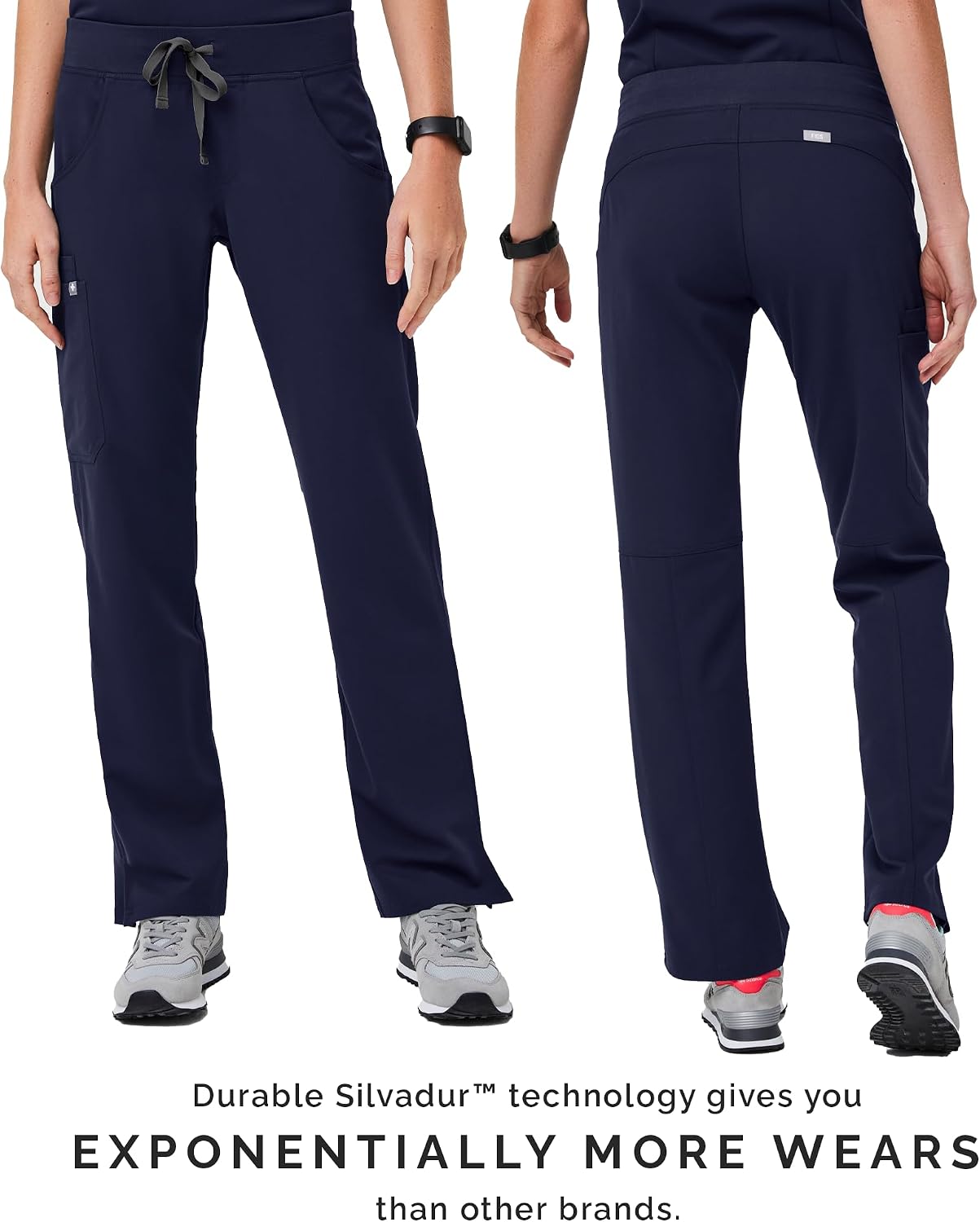
Most healthcare uniforms — called scrubs — come as a matched set: a top and a pair of pants sold together. But once you’ve been on the floor for a year or two, you start noticing that what’s holding your outfit back isn’t usually the top. It’s the pants. The waistband that rolls under your badge reel. The pockets that are technically there but won’t fit a penlight without the pen launching itself across the break room. The inseam that’s either puddling on the floor or cutting into your knee by noon. Upgrading just the pants — while keeping a top you already like — is one of the most efficient gear decisions a mid-career nurse can make, and it costs roughly a third of what a full-set upgrade would. This guide walks you through exactly what to look for, what specs actually matter on a busy unit, and how to match the right pant style to the work you’re actually doing.
| EDITOR'S PICK[Med Couture Scrub Pants For Wom…](https://www.amazon.com/dp/B07GSJWZPK?tag=greenflower20-20) | Mid-tier[Cherokee Scrub Pants for Women…](https://www.amazon.com/dp/B0C9DDHHJW?tag=greenflower20-20) | Budget pick[Dickies EDS Signature Scrubs fo…](https://www.amazon.com/dp/B00SAHZZ6E?tag=greenflower20-20) | |
|---|---|---|---|
| Fit style | Cargo jogger | Mid rise flare | Elastic waist pull-on |
| Pockets count | 5 | 5 | — |
| Fabric type | 2-way stretch | 2-way stretch | Soft brushed poplin |
| Closure type | — | Drawstring | Pull-on |
| Price | $39.95 | $29.99 | $17.59 |
| See on Amazon → | See on Amazon → | See on Amazon → |
Why Pants Are the Load-Bearing Piece of Your Uniform
Your scrub top holds a stethoscope, maybe a pen, and your dignity. Your pants hold everything else: trauma shears, alcohol wipes, a folded-up Kardex printout, your personal phone, your work phone if your unit still issues them, saline flushes, and — if you work nights — probably a granola bar you’ve been meaning to eat since 0200. The American Nurses Association’s Healthy Nurse Healthy Nation ergonomics report from 2024 specifically flags poorly distributed carry load as a contributing factor to lumbar strain on 12-hour shifts. The weight of what you carry doesn’t change; where it sits on your body absolutely does.
Beyond storage, fit at the hip, thigh, and inseam determines how freely you can crouch at a bedside, step over a monitor cable, or do the slightly undignified half-lunge required when a patient needs repositioning. Good fabric with bad proportions still limits you. That’s the case for treating the pants as the primary upgrade target, not an afterthought.
The Specs That Actually Predict Performance
Fabric Weight and Stretch Direction
Fabric weight is measured in grams per square meter (GSM). For scrub pants, the useful range is roughly 130–175 GSM. Below that, you get translucency — an ongoing complaint in aggregated nurse-forum discussions — and faster pilling at the inner thigh where pants rub against each other during a full shift. Above 175 GSM you’re adding thermal weight that most floor environments don’t require and that makes long shifts feel heavier.
Stretch direction matters more than the percentage of spandex in the blend. A fabric rated “4-way stretch” moves with you in all directions — forward, back, and side to side. A fabric with only 2-way stretch (typically just horizontal, along the bias) will feel fine at the fitting room mirror but will bind at the back of the knee when you squat. FIGS’s technical fabric specifications for their 2026 catalog describe their core Catarina and Rafaela fabrications as 4-way stretch with at least 15% stretch recovery — meaning the fabric bounces back to shape rather than bagging out by hour eight. Reviewers across multiple retail platforms consistently confirm that the seat area holds its shape through a full shift, which matches those published specs.
Good Housekeeping’s 2024 guide on reading fabric content labels makes a useful point: “moisture-wicking” is a marketing claim with no standardized testing requirement, while a simple poly-spandex blend above 88% polyester will inherently wick by the nature of the fiber. That’s worth knowing when you’re comparing a $28 pair that says “moisture-wicking” to a $75 pair that just lists its fiber content — the cheaper claim is often the less reliable one.
Pocket Architecture: The Measurable Part
Pocket depth is a real spec, not a feeling. Here’s a quick benchmark to carry into your next purchase decision:
By the numbers:
- Utility pocket (thigh): 7 inches deep minimum to carry a phone flat without the screen catching on the edge
- Cargo pocket (side): 5 inches wide to hold a 60mL syringe without deforming the pocket wall
- Back pocket: 4.5 inches deep to keep a folded patient list from escaping when you sit
- Hidden waistband pocket (found on some premium styles): wide enough to hold a folded $20 and your ID card — useful for travel nurses between assignments
Jaanuu’s antimicrobial fabric white paper from 2025 notes that their design process includes ergonomic pocket placement testing — specifically that cargo pockets positioned at mid-thigh rather than upper-thigh reduce the forward hitch in gait that many nurses report with overstuffed upper-thigh pockets. That placement difference is worth looking at when comparing product photos, not just spec sheets.
Fit Tradeoffs by Body Type and Specialty
The Waistband Decision
There are three waistband architectures you’ll encounter:
Drawstring-only: Maximum adjustability, tends to roll or knot. Popular in budget tiers. Fine if you’re between sizes; frustrating if you need a secure waist during fast movement.
Elastic-panel with no drawstring: Clean silhouette, limited adjustability. Works well if your size falls squarely in a standard range. Reviewers who work in procedural areas — cath lab, OR, endoscopy — consistently favor this style because there’s no drawstring to catch on sterile equipment or table rails.
Hybrid (wide elastic waistband with interior drawstring): The format most commonly praised in aggregated reviews from floor nurses and ICU staff. The elastic holds the pant in place during repositioning; the drawstring handles end-of-shift bloat and the reality that your hip measurement at 0700 and 1900 are not the same number. FIGS Rafaela and most Jaanuu core-line pants use this architecture. It’s worth paying for.
Inseam and Hem Choices
Most scrub brands offer a 30-inch inseam as standard, with petite (28”) and tall (32”–34”) options. The Journal of Nursing Administration’s 2023 study on occupational clothing satisfaction identified fit at the hem as the single most-cited source of dissatisfaction in nursing uniform surveys — ahead of fabric quality and pocket depth. A hem that drags collects floor contamination; a hem that’s too short exposes your ankle and triggers patient comments that some nurses find undermining their authority, particularly in newer graduates.
Tapered-leg cuts have moved into mainstream scrub design over the past two to three years. If you work in a high-mobility specialty — pediatrics, psych, med-surg covering a large unit — a straight or athletic cut through the thigh with a tapered hem gives you movement range without the wide hem catching on equipment. For sedentary specialty areas (radiology, clinic nursing, telehealth oversight), the silhouette matters more than the athletic cut, and a more tailored jogger-style pant is appropriate.
Specialty-Specific Notes
ICU/Critical care: You’re not moving as far per shift as a med-surg nurse, but you’re doing more deep-crouch work at bedside equipment. Prioritize 4-way stretch and thigh pocket depth for full syringes.
Med-surg/High-volume floor nursing: Volume of carry is the dominant variable. Maximum pocket count matters; look for pants that include both a cargo pocket and a phone-sized utility pocket on the same side.
Psych/Behavioral health: Drawstrings and dangling hardware are contraindicated in many unit policies. Fully elasticized waistbands with no exterior ties are the standard. Confirm your unit’s dress code before purchasing drawstring styles.
OR/Procedural: Sterile field considerations mean minimal exterior hardware and no cargo pockets that could brush a sterile tray. Classic OR-style pants — elastic waist, straight leg, no cargo — are the right call regardless of how much you love your thigh pocket on the floor.
Travel nursing: You’re packing for multiple assignments. Wrinkle recovery is a real spec — polywrap fabrics that look presentable after being folded in a duffel for a week are worth paying more for. Reviewers specifically praise the Jaanuu core line for fold-recovery performance across multiple wash cycles.
The Price Tiers — What You’re Actually Paying For
Budget tier ($20–$35): Cherokee Workwear and similar brands. Functional; pocket depth is adequate but not optimized. Fabric tends toward heavier GSM, which reads as durable but can feel warm. Fine as a second-pair backup or for orientation week before you know what your unit requires.
Mid-range ($45–$70): FIGS Rafaela, Dickies Balance, and comparable styles. This is where 4-way stretch and hybrid waistbands become standard rather than premium features. The cost-per-wear math favors this tier for nurses buying one or two pairs for daily rotation — quality holds through roughly 80–100 wash cycles before significant pilling, per owner reviews across major retail platforms.
Premium ($80–$120): Jaanuu tailored cuts, Medelita clinical pants for advanced-practice settings. You’re paying for precision sizing (including half-sizes in some lines), antimicrobial fabric treatments, and design-led pocket architecture. The per-pair cost is real, but for nurses who treat their uniform as a professional identity investment — charge nurses, travel nurses building a carry kit, NPs seeing patients independently — the return on credibility and comfort is consistently cited in long-form reviews.
The Decision Rule
If your current pants are a budget-tier pair that are pilling or losing their waistband shape after 6 months, upgrade to mid-range before adding more pairs — you’re spending the same money faster on replacements.
If your pants fit fine but your pocket situation is making every shift a game of Tetris with your gear, identify your specialty’s dominant carry items (phone size, syringe count, penlight preference) and match pocket architecture to that list before choosing a brand.
If you’re in psych or the OR, confirm your unit’s dress code on drawstrings and hardware before any purchase — a $90 pair you can’t wear on your unit is a $90 mistake.
If you’re a travel nurse building a per-assignment kit and packing light, prioritize fold-recovery and wrinkle resistance over raw pocket count — you can supplement carry with a fanny pack or badge reel pouch, but you can’t iron your pants in a hotel bathroom at 0530 and win.
The pants upgrade isn’t glamorous. It’s also one of the highest-impact changes you can make to how you function across a full shift — and it costs less than a single tank of gas more than the pair you’re already replacing.