You finished your last clinical rotation, passed NCLEX, and now you’re staring at a first-shift date on the calendar — which means you’re also staring at a list of things to buy that nobody handed you in a syllabus. A “starter kit” for nursing isn’t a branded box you order off a shelf; it’s a set of decisions about scrubs (the uniform-style clothing nurses wear), footwear, compression socks (specialized hosiery that applies graduated pressure to the legs to reduce swelling and fatigue during long standing shifts), diagnostic tools, and small accessories that will either support your performance on day one or quietly sabotage it by month three. This guide cuts through the marketing noise to give you a prioritized, tiered framework — what to buy now, what to upgrade after your first paycheck, and what you can almost certainly skip until you know your unit’s actual demands. We’ll show the math, name the tradeoffs, and close with clear if-then rules so you can make decisions tonight.
The Non-Negotiables: Gear You Cannot Show Up Without
Scrubs
Your hospital or employer will dictate color and sometimes brand. Before you spend a dollar, get that policy in writing — many systems have a specific color-per-unit standard (navy for ICU, ceil blue for OR, etc.), and some have vendor contracts that give you a discount.
Budget tier: Cherokee Workwear scrubs run $15–$25 per piece and are the default choice for good reason. Reviewers across aggregated nursing forums consistently describe them as durable through institutional laundering, which is the most punishing wash cycle your scrubs will ever face. The fit is utilitarian rather than tailored, pocket placement is functional, and the fabric doesn’t pill aggressively in the first six months — a real concern at this price point. For a new grad who doesn’t yet know whether they’ll stay in med-surg or pivot to a procedural specialty that requires different pocket layouts, buying three sets of Cherokee Workwear to start is the low-regret move.
Mid-range: If your unit allows self-selected scrubs and you want something that photographs better for your new employee badge, FIGS Rafaela sets ($60–$80) are worth considering after your first paycheck. Owners consistently report that the four-way stretch holds its shape through 12-hour shifts and that the tailored silhouette reads as more professional in environments like outpatient clinics or charge-facing floors. The tradeoff is laundering sensitivity — FIGS recommends cold water and no high heat, which adds friction to a tired post-shift routine.
Decision rule: If you don’t know your unit’s dress code yet, buy two Cherokee sets for orientation week. You’ll know within 30 days whether a mid-range upgrade makes sense for your specific floor.
Footwear
The American Nurses Association’s Healthy Nurse Healthy Nation data consistently identifies musculoskeletal strain as one of the top occupational health concerns for floor nurses — and footwear is the first intervention you control. The Bureau of Labor Statistics Occupational Outlook Handbook for Registered Nurses notes that RNs are on their feet for the majority of a shift, often covering four or more miles per 12-hour block.
OSHA’s healthcare ergonomics guidance document recommends footwear with adequate arch support and slip-resistant outsoles as a basic protective measure for healthcare workers.
Entry-level: Dansko Professional clogs ($130–$160) have a decades-long track record among floor nurses. The rocker-bottom sole (a curved outsole designed to reduce the energy needed at toe-off, easing stress on the forefoot) is well-documented in owner reviews as reducing end-of-shift foot fatigue. The leather upper is easy to wipe down after exposure incidents. The tradeoff: the break-in period is real. Reviewers consistently report 2–3 weeks of discomfort before the clog conforms to the foot. Don’t wear brand-new Danskos for your first 12-hour orientation shift.
Upper-mid: On Running nursing shoes ($140–$170) have crossed over into clinical settings as nurses with plantar fasciitis (heel pain caused by inflammation of the tissue connecting the heel bone to the toes) seek cushioning that Dansko’s firmer platform doesn’t provide. Owners in aggregated reviews note exceptional cushioning for nurses who are also runners or have high-arch foot structures. The limitation is slip-resistance — confirm the specific model meets your hospital’s footwear policy before buying.
Decision rule: If you don’t have a pre-existing foot condition, Dansko Professional is the lower-risk first buy. If you have plantar fasciitis or have been told by a podiatrist you need maximal cushioning, On Running is the better fit.
The High-ROI Upgrade: Compression Socks
This category is persistently underestimated by new grads and overdue for a clear-eyed look at the evidence.
A 2023 paper published in the Journal of Nursing Administration (LWW) found that nurses who wore graduated compression hosiery — socks or stockings that apply the most pressure at the ankle and progressively less pressure moving up the leg — reported significantly lower end-of-shift leg fatigue scores than those who did not. The mechanism is well-understood: standing for extended periods allows blood to pool in the lower legs; compression counteracts that pooling and keeps venous return (blood moving back toward the heart) more efficient.
By the numbers:
- Entry-level compression socks (15–20 mmHg): $12–$25/pair
- Mid-range graduated compression (20–30 mmHg, Therafirm or similar): $30–$50/pair
- Premium compression systems (Sigvaris, true medical-grade 20–30 mmHg): $50–$90/pair
The mmHg (millimeters of mercury) number is the pressure rating — higher numbers mean more aggressive compression, which is appropriate for nurses with varicose veins or those who stand with minimal movement. For most new grads on a general med-surg floor, 15–20 mmHg is the correct entry point; 20–30 mmHg is appropriate if you already notice significant leg swelling or fatigue.
Decision rule: Don’t skip this category to save $15. Buy at minimum one quality pair before your first shift. Sigvaris or Therafirm at the 20–30 mmHg range are the picks supported by owner reviews for durability through repeated institutional laundering.
Clinical Tools: The Stethoscope Decision
This is where new grads most often either overspend (buying a top-tier stethoscope before they’ve developed the auscultatory skills to differentiate what they’re hearing) or underspend (buying a $20 disposable that makes cardiac assessment genuinely harder).
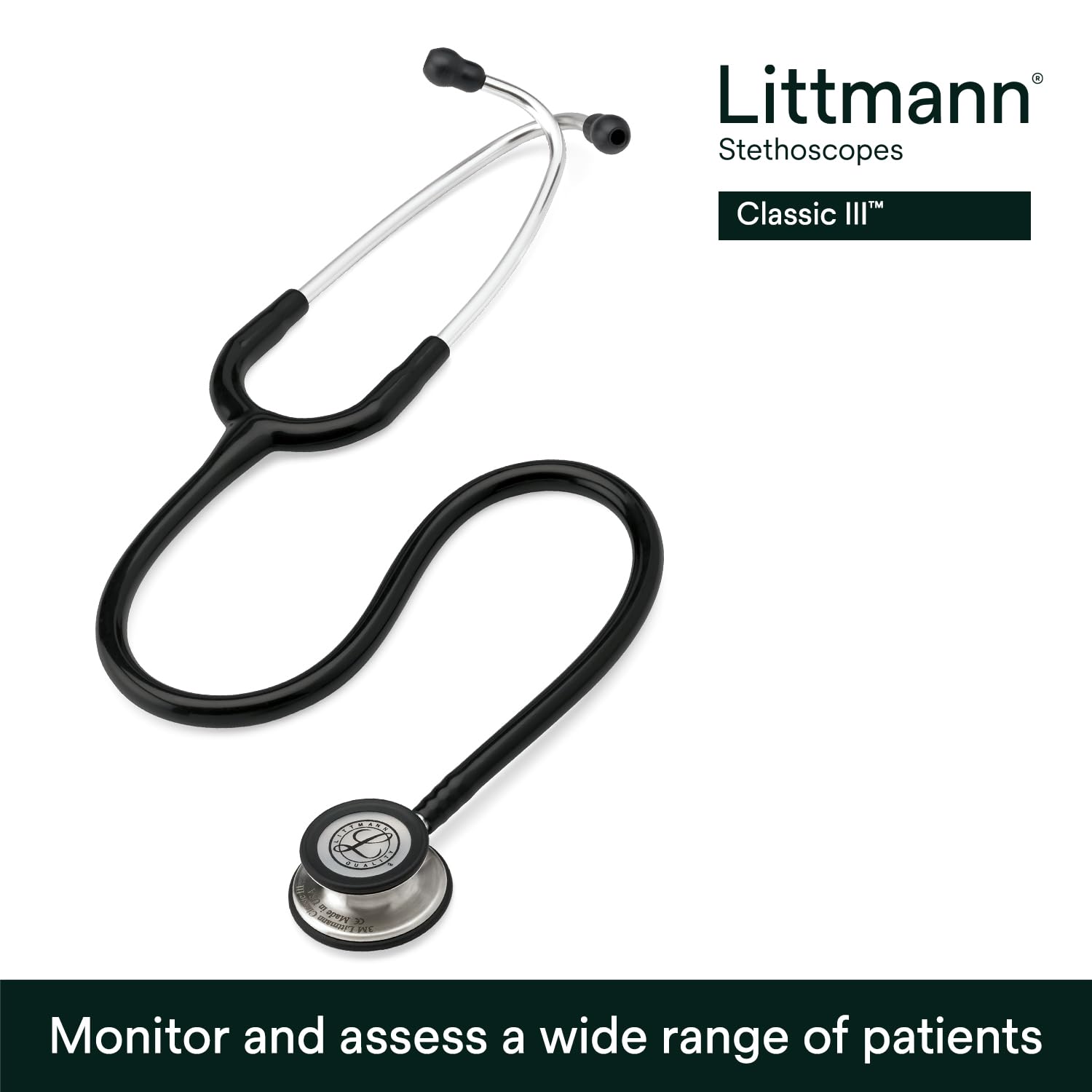
Wirecutter’s updated “Best Stethoscopes” review (2025) makes the case clearly: the 3M Littmann Classic III ($120–$140) is the correct first stethoscope for most new graduate nurses. It’s acoustically strong enough for general assessment across all standard clinical environments, durable enough to last years, and priced at a point where losing it during a travel assignment doesn’t constitute a financial crisis.
The 3M Littmann Cardiology IV ($200–$250) is a meaningful upgrade for nurses moving into cardiac ICU, step-down, or any setting where subtle heart murmurs (abnormal sounds caused by turbulent blood flow) and lung sounds must be differentiated precisely. The dual-sided chestpiece and enhanced acoustics are worth the premium after you know you’re staying in a cardiology-adjacent specialty. Buying a Cardiology IV before your first med-surg shift is a bet on a specialty you haven’t entered yet.
Accessory note: Engrave or label your stethoscope immediately. It is the single most commonly borrowed and misplaced item in any unit.
The Pocket Essentials: Small Gear With Outsized Impact
Trauma shears: A pair of heavy-duty bandage scissors for cutting away clothing or dressings in emergencies. Buy one decent pair ($8–$15) and keep it clipped. This is not where to invest in premium; they will be lost or borrowed into oblivion.
Penlight: A small flashlight used for pupillary assessment — checking whether a patient’s pupils constrict appropriately in response to light, a quick neurological check. Any reliable penlight in the $10–$15 range works. Reusable versions with pupil gauge markings printed on the barrel are preferred by reviewers over disposables.
Watch with a second hand: You need an analog second hand for manual pulse and respiratory rate counting. A simple waterproof clip-on fob watch (a watch that clips to your scrub pocket rather than wearing on the wrist, reducing infection transmission risk) runs $15–$25 and is standard on most hospital floors.
Badge reel and ID holder: Functional, not glamorous. A retractable badge reel with a breakaway connection (a clip that releases under pressure, preventing strangulation risk if a patient grabs the lanyard) is a safety requirement on many floors.
What to Skip Until Month Three
Specialty diagnostic tools: Ophthalmoscopes (for examining the eye’s interior), otoscopes (for examining the ear canal), and advanced wound care accessories belong on your list only after you know your specialty. They’re expensive and floor-specific.
Premium lab coat: Medelita and similar tailored lab coats are genuinely well-made and project credibility in NP or clinic settings — but if you’re starting on a floor that doesn’t use them, it’s a $150 item hanging in a closet.
Multiple stethoscope colors or customization: Spend the $200+ on a Cardiology IV only once your unit and specialty are confirmed. Color upgrades and engraving options are fine but secondary.
The Full Decision Framework
| Situation | Recommendation |
|---|---|
| Dress code unknown, starting orientation | 2 Cherokee Workwear sets, add more after policy confirmed |
| No pre-existing foot condition | Dansko Professional clogs — buy 2 weeks before shift to break in |
| History of plantar fasciitis | On Running nursing shoe — verify slip-resistance with HR |
| General med-surg or telemetry floor | Littmann Classic III stethoscope |
| Confirmed cardiac ICU or step-down placement | Upgrade to Littmann Cardiology IV |
| No leg swelling history | 15–20 mmHg compression socks, one quality pair minimum |
| Existing varicose veins or noted leg fatigue | 20–30 mmHg, Sigvaris or Therafirm |
The goal of a starter kit isn’t to buy everything — it’s to avoid the two or three purchases you’ll regret making on the wrong side of your first paycheck. Get the scrubs, shoes, compression, and stethoscope right, and you’ll have a functional professional kit that carries you through your first unit without re-buying anything essential. The upgrades will make themselves obvious once you know your floor, your specialty, and your body’s specific demands after a real 12-hour shift.