A stethoscope is the tool that lets a clinician listen to sounds inside the body — heartbeats, lung airflow, bowel activity — by pressing a sensor against the skin and routing those sounds to the ears. Most nurses carry an analog stethoscope, which is a purely mechanical device: sound waves travel through an air-filled tube to your ears, with no electronics involved. A digital stethoscope (also called an electronic stethoscope) converts those same body sounds into an electrical signal, amplifies the signal, and delivers it to your ears — often at 20 to 40 times the volume of an acoustic model. Some models record sounds to an app for later review or teleconsultation. The difference matters more in some clinical settings than others, and if you work in an ICU or cardiac unit, it may matter a great deal. This article walks through exactly when digital is worth the price jump, when it isn’t, and which models the spec sheets and aggregated clinical reviews point toward.
Why the ICU and Cardiac Floor Are Different from Every Other Unit
Noise is the first issue. ICU and step-down cardiac units are genuinely loud environments — ventilators cycle, IV pumps alarm, bed rails clatter, overhead pages run on a continuous loop. A standard acoustic stethoscope is essentially a passive cone: it cannot distinguish between the breath sound you’re trying to hear and the ventilator hum in the background. Nurses who work these floors consistently report, across forum discussions and in published nursing journals, that ambient noise is a meaningful barrier to confident auscultation. A 2023 paper in the Journal of Nursing Care Quality (journals.lww.com) found that electronic stethoscopes with ambient noise reduction improved detection accuracy for abnormal lung sounds by a statistically significant margin in ICU settings compared to standard acoustic instruments.
The second issue is clinical stakes. On a medical-surgical floor, missing a faint bowel sound has different consequences than missing a subtle S3 or S4 gallop (extra heart sounds that can indicate heart failure or a stiff, overloaded ventricle) in a post-CABG patient. In cardiac care, the auscultation findings you document shape downstream orders — a murmur you weren’t sure about can mean the difference between watching and calling the rapid response team. The American Association of Critical-Care Nurses’ practice resources on auscultation consistently frame confident acoustic assessment as a core critical-care competency, not a nice-to-have.
The third factor is earpiece fatigue. Nurses working 12-hour shifts already report higher rates of noise-induced listening strain. Digital amplification can actually lower the effort required to hear clearly, which matters across a full shift.
What You Actually Get (and Don’t Get) with a Digital Stethoscope
What you get:
- Amplification: Most clinical-grade digital stethoscopes are manufacturer-rated at 24x to 40x sound amplification over ambient acoustic performance. The 3M Littmann CORE Digital Stethoscope, for example, is rated by the manufacturer at up to 40x amplification with active noise cancellation mode engaged.
- Ambient noise reduction: Electronic filtering attenuates background noise while preserving the frequencies typical of cardiac and respiratory sounds. Reviewers in clinical settings note this is most useful above 70 decibels of ambient noise — which describes most ICU environments during shift peak hours.
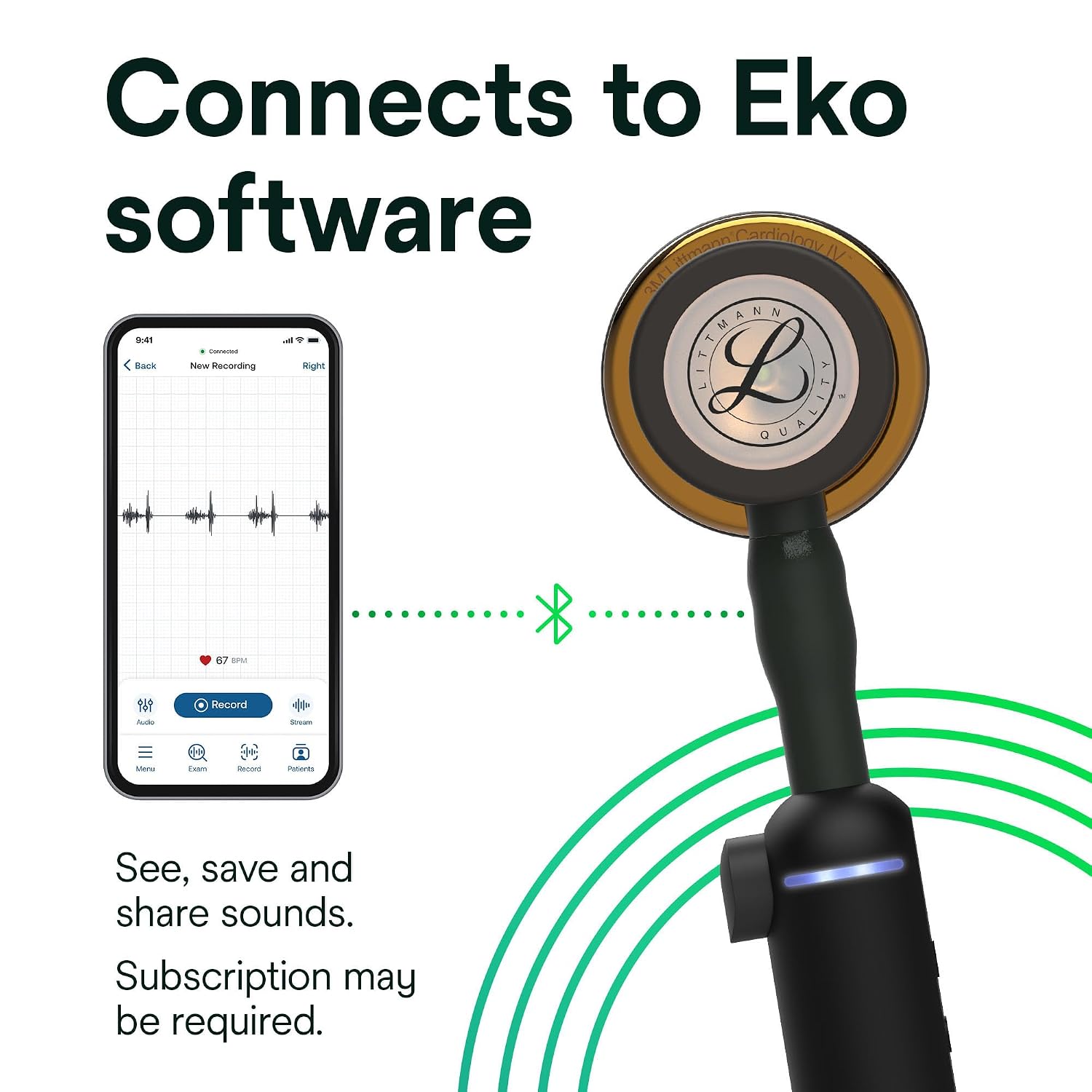
- Recording and telemedicine integration: Several models connect via Bluetooth to companion apps. This allows you to record a sound you’re uncertain about, share it with a cardiologist via teleconsultation, or store it in a patient note workflow where the facility’s policy permits. Medscape’s 2024 clinical comparison of digital versus analog stethoscopes highlights this as the feature most valued by advanced practice clinicians in remote or telehealth-integrated settings.
- Hearing accessibility: For nurses with hearing loss — a more common career circumstance than most training programs acknowledge — digital amplification can extend clinical usefulness significantly.
What you don’t get:
- A substitute for clinical judgment. A digital stethoscope amplifies everything, including artifact (unwanted noise from movement or poor seal). Owners consistently report a short learning curve to distinguish true sounds from amplified artifact, particularly with the diaphragm-to-skin contact technique.
- Indestructibility. The electronics add complexity, and the chest pieces on digital models are generally less field-resilient than a machined brass analog chest piece. A Littmann Cardiology IV dropped on a hard floor typically survives. The CORE Digital is durable but has more failure points.
- Budget friendliness. This is the hard math.
The Numbers
| Model | Type | MSRP (2026) | Amplification | Bluetooth / Recording |
|---|---|---|---|---|
| 3M Littmann Cardiology IV | Analog | $215–$250 | Passive acoustic | No |
| 3M Littmann CORE Digital | Digital | $280–$320 | Up to 40x + ANC | Yes (Eko app) |
| Eko DUO 3 (cardiac-focused) | Digital + ECG | $399–$449 | 40x | Yes |
| Eko CORE 500 | Digital | $199–$229 | 40x | Yes |
Prices reflect average retail and authorized-dealer ranges as of May 2026. Travel nurse agency buyers and volume procurement accounts often access institutional pricing 10–15% below MSRP.
The Cardiology IV is the gold standard analog comparison point — if you already own one and work in a quiet-enough environment, the case for upgrading narrows. The CORE Digital is roughly $60–$80 over the Cardiology IV at street price, which for most full-time nurses represents less than a shift’s net earnings. The Eko DUO 3 adds a single-lead ECG (a way to capture the heart’s electrical activity, not just its sounds) built into the chest piece, which is a different value proposition for cardiac nurses specifically.
ICU vs. Cardiac: The Tradeoff Is Not the Same
ICU nursing tends to prioritize lung sounds and hemodynamic monitoring — you’re listening for crackles (bubbling sounds suggesting fluid in the airways), absent breath sounds, or pleural rubs (a rough scraping sound indicating inflammation around the lungs). Digital amplification with noise cancellation directly addresses the ventilator and alarm noise problem. The Eko CORE 500 or Littmann CORE Digital are well-reviewed by ICU nurses as the entry point that meaningfully changes assessment confidence at a reasonable price step-up.
Cardiac nursing — step-down, telemetry, cath lab — deals more with heart sounds: murmurs, extra beats, pericardial friction rubs. The frequency filtering profiles on the Eko DUO 3 are specifically tuned for low-frequency cardiac sounds (the S3 and S4 gallops mentioned earlier sit at 20–100 Hz, at the floor of what a standard stethoscope transmits reliably). Across aggregated reviews from cardiac nurses and nurse practitioners on clinical product platforms, the DUO 3’s cardiac-frequency optimization is the cited differentiator — not the ECG feature, though that’s useful in a cardiac NP’s workflow. The ECG capability is, honestly, more relevant to advanced practice roles than to bedside RNs; most facilities have continuous telemetry, so a single-lead ECG in your stethoscope is supplemental rather than transformative for the staff RN.
Per Healthline’s overview of what to look for in stethoscopes, frequency response range — the spread of sound pitches a stethoscope reliably picks up — is the specification that most directly predicts clinical usefulness for cardiac assessment, more so than amplification level alone.
Who Should (and Shouldn’t) Upgrade
Upgrade to digital if:
- You work in an ICU, CVICU, cardiac step-down, or any unit where ambient noise consistently makes you second-guess your auscultation findings.
- You have any degree of hearing loss or progressive hearing fatigue across your shifts.
- You’re in a teleconsultation-integrated workflow or work with a cardiologist who has asked to hear recordings remotely.
- You’re a cardiac NP or CRNA and the Eko DUO 3’s ECG integration fits your scope of practice.
- You’re a travel nurse who rotates through high-acuity environments: the flexibility of digital amplification covers more settings than a specialist analog tool.
Stick with a quality analog if:
- You work in a consistently quieter environment (pediatric outpatient, school nursing, general med-surg) where ambient noise isn’t a real barrier.
- You already own a Littmann Cardiology IV or Cardiology III in good condition and your auscultation findings are confident and accurate. The marginal improvement may not justify the spend.
- Your facility has strict infection-control policies that limit bringing personal electronic devices into isolation rooms. Worth checking your unit policy before purchasing any Bluetooth-enabled device.
- You’re early in your career and still building baseline auscultation skill: some experienced educators note that learning on amplified sound first can delay the development of nuanced listening technique on standard equipment. This is a minority view, but worth noting if you’re in a training context.
The “If X, Then Y” Decision Rule
If you’re an ICU or CVICU nurse dealing with real ambient noise interference: the Littmann CORE Digital is the most straightforward upgrade — it builds on the Littmann quality reputation nurses already trust, the app integration is optional rather than mandatory, and the price premium over the Cardiology IV is modest enough to justify on comfort and confidence grounds alone. Based on published specs and owner feedback aggregated across clinical review platforms, this is the one worth considering first.
If you’re a cardiac bedside RN who specifically wants better low-frequency heart sound detection: look at the Eko CORE 500 as the entry point. It’s priced below the Littmann CORE Digital at street price and the cardiac-frequency tuning is its core design brief.
If you’re a cardiac NP or CRNA and a single-lead ECG at the bedside would actually change your workflow: the Eko DUO 3 earns its higher price. For a staff RN without that scope of practice, it’s a feature you’d probably pay for and rarely use.
If the budget is the constraint right now: a well-maintained Littmann Cardiology IV is still a clinically excellent instrument that the American Heart Association’s cardiac monitoring guidance treats as the acoustic baseline for serious cardiac assessment. Don’t underestimate it. The digital upgrade is a meaningful step up — not a requirement.
The real question isn’t “is digital better?” In controlled conditions, yes, digital amplification with noise cancellation is measurably superior for high-noise, high-acuity listening. The real question is whether your specific floor context makes that superiority matter enough to justify the cost and the small learning curve. For most ICU and cardiac nurses working full-time in busy units, the honest answer, based on the evidence and the pattern of what experienced nurses in those settings consistently report, is yes.