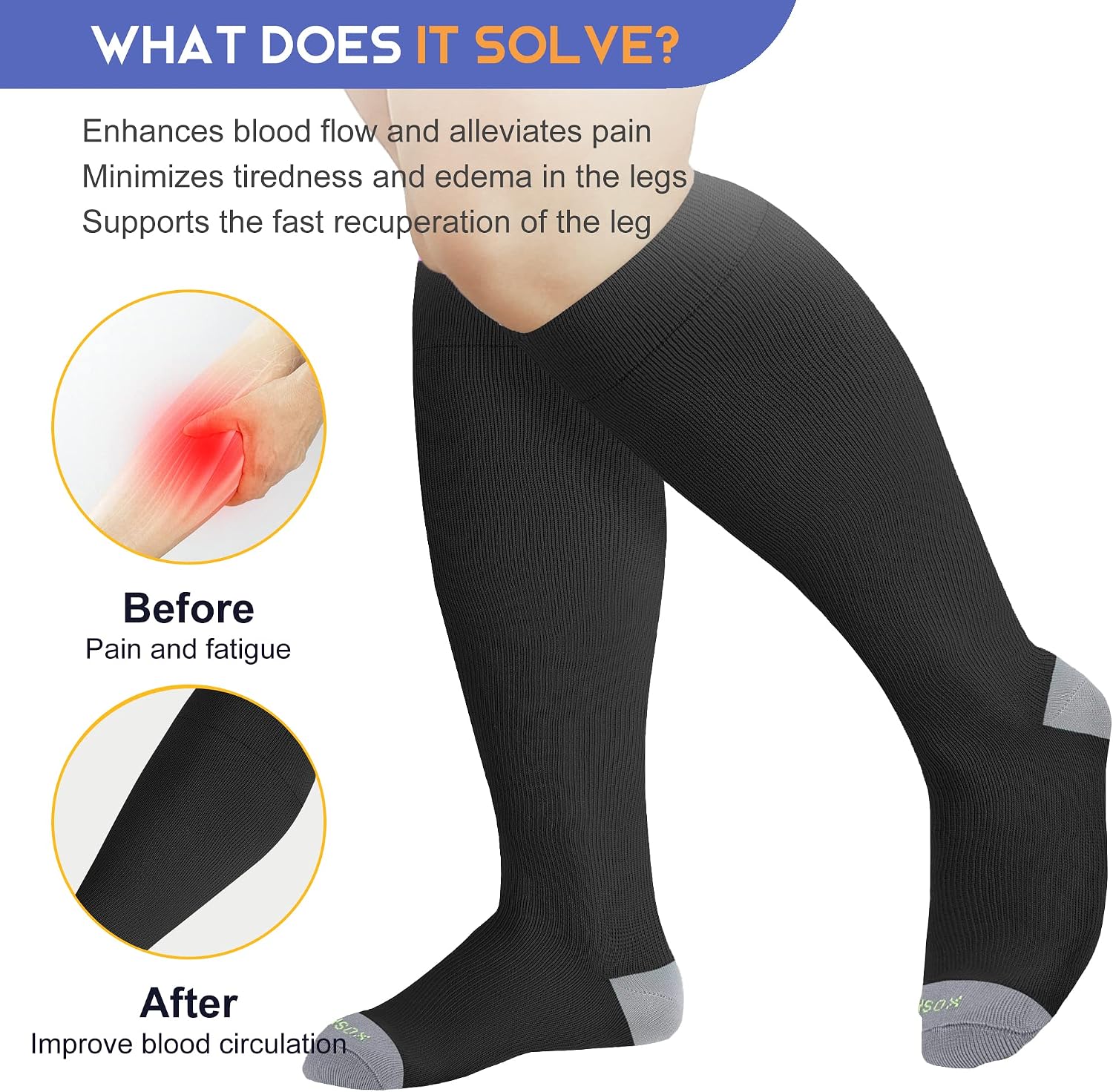
If you have ever grabbed a 12-hour shift’s worth of optimism and a brand-new pair of compression socks — only to spend the last four hours of that shift peeling the cuff away from a red welt on your calf — you already understand the problem this article is here to solve. Compression socks are exactly what the name suggests: hosiery engineered to apply graduated pressure (meaning the squeeze is tightest at the ankle and gradually eases up toward the knee) to help push blood back toward the heart. On a floor where you log eight to twelve miles a day on hard surfaces, that graduated squeeze reduces swelling, combats fatigue, and over a career, lowers your risk of varicose veins and deep-vein complications. The trouble is that the sizing systems most brands use were built around a narrow population range, and if your calf circumference runs wider than the industry’s assumed average — roughly 14–16 inches — standard sizing simply stops working. This guide is about closing that gap: what specs actually matter, which brands have done the engineering work for wider calves, and how to choose without wasting another $30.
Why Standard Compression Socks Fail Wider Calves (and What Goes Wrong Clinically)
The failure mode is almost always the same. A sock sized by shoe size or height/weight chart gets the foot and ankle pressure roughly right, but the cuff — the band at the top of the sock — is dimensioned for a calf of 14 to 16 inches. If your calf runs 17, 18, or 20 inches, that cuff acts as a tourniquet. Instead of graduated compression that eases as it travels up the leg, you get a reversal: moderate pressure at the ankle, then a hard band of constriction at the calf top that can impede venous return rather than assist it.
Per Healthline’s overview of compression therapy, the therapeutic window for most clinical compression garments is 15–20 mmHg for mild fatigue and edema prevention, and 20–30 mmHg for nurses with a history of varicose veins or those on prolonged-standing assignments. (mmHg stands for millimeters of mercury — the same unit used to measure blood pressure; it quantifies how much squeezing force the fabric delivers.) When a too-tight cuff cuts off circulation, you lose the gradient entirely. The sock becomes cosmetically compressive at best and physiologically counterproductive at worst.
The American Nurses Association’s Healthy Nurse Healthy Nation musculoskeletal health resources note that prolonged standing is one of the top contributors to occupational injury in nursing — and that supportive hosiery is among the lowest-cost interventions available. The problem, as any plus-size nurse knows, is that “available” on the label doesn’t mean “designed for your body.”
The Specs That Actually Matter: A Quick Reference
Before you evaluate any brand, three numbers determine whether a sock will work for your build:
By the Numbers
| Spec | What it means | Target range for wide-calf fit |
|---|---|---|
| Calf circumference coverage | Maximum calf width the sock can accommodate without reversing gradient | Look for 18–22 in. stated max |
| Compression class | mmHg rating — therapeutic force delivered | 15–20 mmHg (mild) or 20–30 mmHg (moderate) |
| Fabric stretch recovery | How well the sock returns to shape after washing | Nylon/spandex blends rated for 200+ wash cycles |
Calf circumference is the single most important number, and it is the one most brands bury in a size chart footnote or omit entirely. If a product page shows a size chart based only on shoe size and height, treat that as a warning sign. Brands that have genuinely engineered for wider builds state calf circumference ranges explicitly — and those ranges typically top out at 18 to 22 inches in purpose-built wide-calf SKUs.
Brands That Have Done the Engineering Work
Sigvaris: The Clinical Benchmark
Sigvaris is the brand most frequently cited in clinical compression literature, and their 2024 product specification guide distinguishes between their standard sizing (calf circumference up to approximately 15.5 inches) and their “Wide Calf” extended series, which accommodates up to 22 inches. The compression delivery in Sigvaris garments is manufactured to ISO 11092 and RAL-GZ 387 standards — meaning the stated mmHg gradient has been independently verified rather than self-reported. For nurses shopping in the 20–30 mmHg therapeutic range, Sigvaris 860 Traveler or the 412 Cotton Comfort series in wide-calf sizing are the options most cited by reviewers in clinical occupational health forums as reliably maintaining gradient across a full shift. Retail positioning runs $50–$90 per pair — a price point that is defensible if the sock is replaced every six months rather than every six weeks because it actually fits.
Therafirm: Core-Spun Technology for Durability
Therafirm’s internal white paper on Core-Spun technology describes a construction method where the compression yarn is wrapped around a stabilizing fiber core, which gives the fabric more dimensional recovery across a shift. In practice, owners of Therafirm’s wide-calf line — which tops out at a stated 20-inch calf maximum — consistently report that the sock holds its compression gradient through a full 12-hour shift without rolling down or bunching at the ankle, two complaints that dominate reviews of cheaper wide-calf options. Therafirm retails in the $25–$50 range, making it the strongest value pick for nurses who want clinical-grade compression without the Sigvaris price tag. The wide-calf sizing is a separate SKU from their standard line; confirm you’re ordering from that specific range, not a standard sock upsized by shoe size.
Jobst Activewear: The Middle Ground
Jobst’s Activewear series is frequently mentioned alongside Sigvaris in occupational therapy circles as a clinically reliable brand. Their wide-calf options cap out around 18 inches of calf circumference, which covers a meaningful portion of the plus-size nursing audience but not the full range. If your calf measures 17 to 18 inches, Jobst Activewear in the 15–20 mmHg range offers a good balance of availability (widely stocked, including through medical supply channels) and verified compression delivery. Above 18 inches, owners report the familiar cuff-bite problem, so this is a conditional recommendation tied to your specific measurement.
Budget-Tier Reality Check: What You Lose Below $15
Compression socks retailing under $15 — the category that dominates search results for “compression socks nurses wide calf” — are almost uniformly sized by shoe size only, and the compression rating is manufacturer-self-reported without third-party verification. Across aggregated reviews of this category, the consistent pattern is: looks right out of the package, holds gradient for two to four weeks of regular washing, then loses meaningful compression and becomes a thick sock with mild squeeze. For a nurse doing a clinical rotation or a single short assignment, that lifecycle may be acceptable. For a floor nurse doing five shifts a week, the cost-per-use math inverts quickly — two pairs of $30 Therafirm socks outlasting eight pairs of $12 generics over a year is a scenario reviewers describe repeatedly.
How to Measure Yourself Correctly (Because Most Nurses Haven’t)
This sounds obvious, but the number of misfit purchases that trace back to incorrect self-measurement is significant. The calf circumference for compression sizing is taken at the widest point of the calf — typically 4 to 6 inches below the back of the knee — while standing. Not sitting, not post-shift when your legs are swollen, not approximated from a pants size. Standing, mid-morning, before a shift, with a flexible measuring tape. Take the measurement twice and use the larger reading.
The NIOSH fact sheet on prolonged standing notes that lower-limb edema in workers who stand for extended periods can add measurable volume to calf circumference by the end of a shift — up to a centimeter in some cases. This means you should size for your baseline measurement, not your post-shift swelling, because the sock needs to deliver therapeutic pressure from the beginning of the shift, not after the swelling has already set in.
Ankle circumference matters too — most brands use it alongside calf circumference for their extended sizing charts. Measure the ankle at the narrowest point, just above the ankle bone.
Specialty and Shift Context: ICU vs. Med-Surg vs. Psych
Compression needs vary by unit, and not just by personal physiology.
ICU and critical care nurses tend to stand in place for longer consolidated periods — bedside procedures, long assessments — versus the more distributed movement of a med-surg floor. Extended static standing increases venous pooling more than walking does, which makes the 20–30 mmHg range more defensible for ICU nurses regardless of build. Sigvaris or Therafirm at that compression class is the clinically appropriate call.
Med-surg and emergency floor nurses cover more distance per shift with more varied movement. The 15–20 mmHg range is sufficient for most nurses in this context without a history of varicose veins, and the priority shifts toward sock durability and cuff stability — a sock that rolls down mid-run is a hazard as much as a comfort issue.
Psych and behavioral health unit nurses should prioritize socks with no prominent seams or decorative elements that could be grasped or used as a ligature concern, and should confirm that the sock profile sits entirely beneath a standard scrub leg opening without requiring adjustment. Many wide-calf compression socks are designed to sit at or below the knee cuff line, which is appropriate; check that the cuff doesn’t extend above the pant line in your specific uniform.
Decision Rules: If X, Then Y
Here is where the comparison resolves into a purchase framework:
-
If your calf is under 16 inches: Standard sizing in any clinical compression brand (Sigvaris, Therafirm, Jobst) will fit correctly. Spend your budget on compression class and fabric quality rather than wide-calf-specific SKUs.
-
If your calf is 16–18 inches: Jobst Activewear wide-calf or Therafirm wide-calf both cover this range. Therafirm’s Core-Spun construction edges out Jobst on durability per review aggregations. Budget $25–$40 per pair; plan to replace every four to six months with regular washing.
-
If your calf is 18–22 inches: Sigvaris wide-calf is the safest choice for verified gradient delivery in this range. Therafirm’s stated 20-inch maximum covers most of this range. Budget $50–$90 per pair for Sigvaris; confirm calf circumference against the brand’s published chart before ordering, not the general size guide.
-
If you are on a travel nurse assignment and need to replace immediately: Therafirm wide-calf is the most widely stocked in this range through medical supply and online channels. Sigvaris may require a longer lead time depending on your assignment location.
-
If budget is the binding constraint: Two pairs of Therafirm at the mid-range price point will outperform four pairs of sub-$15 generics over six months. The cost-per-use math favors the clinical brand even at the tighter budget.
The bottom line: measure your calf standing, verify the brand states a maximum calf circumference (not just a shoe size range), and match compression class to your unit context. The sock that fits and holds its gradient through a 12-hour shift is a clinical tool. The one that cuts in and rolls down is just an expensive inconvenience.