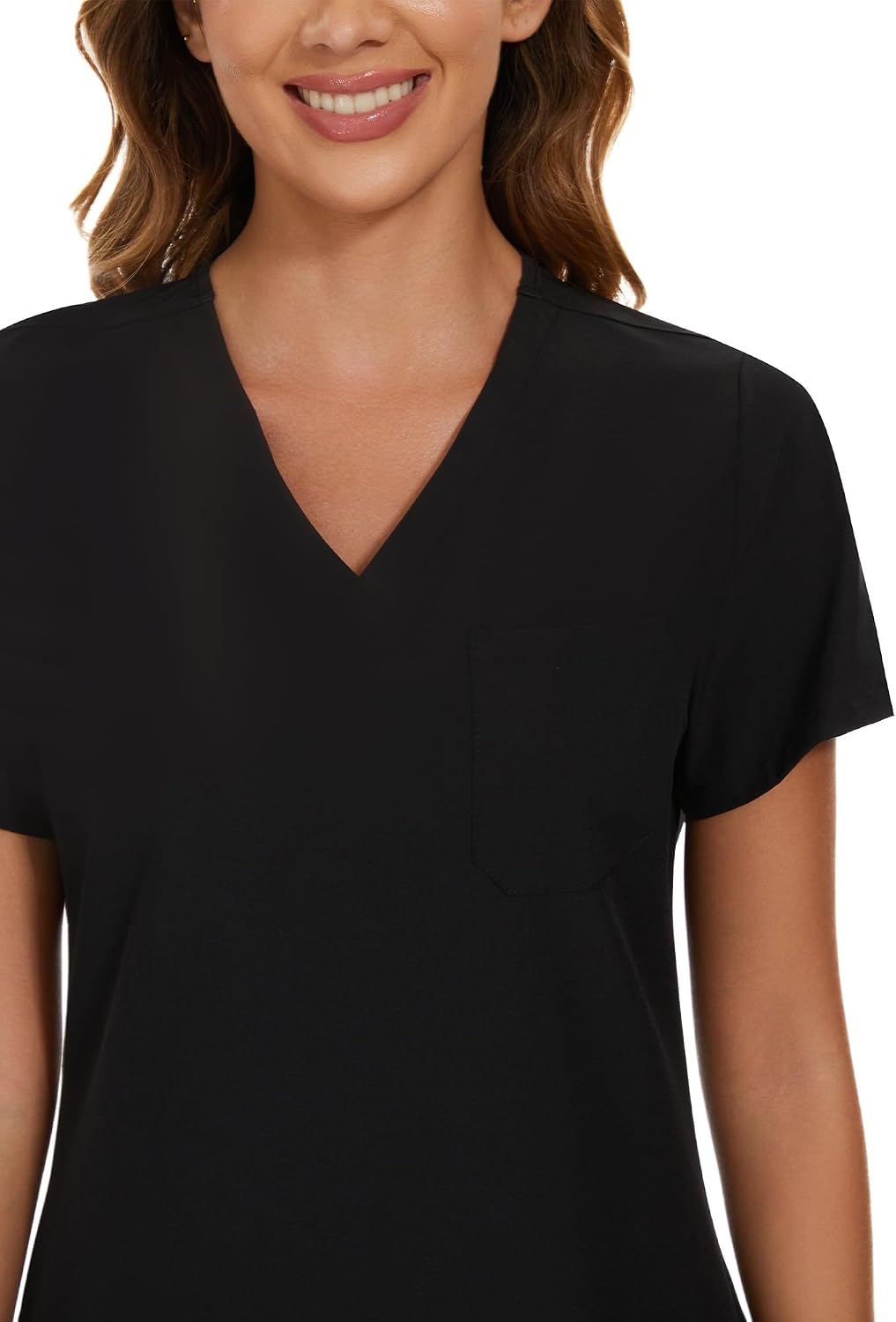
Scrubs are the uniform of nursing — the top-and-pant set you wear to every shift, wash after every shift, and repeat for as long as the fabric holds together. If you’re just starting out, or stretching a paycheck between assignments, a sub-$30 scrub set looks like an easy win. And sometimes it genuinely is. But “cheap” and “good value” are two different things, and the gap between them is exactly what cost-per-wear math is designed to expose. Cost-per-wear is simple: divide what you paid by the number of times you actually wear something before it’s unwearable. A $28 set you replace in four months may cost more per shift than a $65 set that lasts two years. This article walks through that math with real numbers, names the fabric and construction signals that predict durability, and ends with a clear decision rule so you know exactly when to go budget — and when spending more is the cheaper move.
| EDITOR'S PICK[Natural Uniforms Women's Cool S…](https://www.amazon.com/dp/B0CKDH6VKF?tag=greenflower20-20) | Mid-tier[Dagacci Scrubs Medical Uniform…](https://www.amazon.com/dp/B01KKHYXCS?tag=greenflower20-20) | Budget pick[COZYFIT Scrubs for Women Set -…](https://www.amazon.com/dp/B0DPWZ9F6R?tag=greenflower20-20) | |
|---|---|---|---|
| Pockets | — | — | 8 |
| Fit type | Regular/Petite | — | — |
| Fabric | Stretch | — | Stretch |
| Gender | Women's | Unisex | Women's |
| Sizes offered | Large | Medium | Small |
| Color in title | Lavender | Navy | Black |
| Price | $29.99 | $24.99 | $19.99 |
| See on Amazon → | See on Amazon → | See on Amazon → |
Why Cost-Per-Wear Is the Right Frame for Scrubs
Most clothing math ignores how hard scrubs are used. A going-out shirt might get washed once a month. Scrubs get washed after every single shift — sometimes twice if you pick up back-to-back days. The American Nurses Association notes in its staffing resources on nursingworld.org that the majority of floor nurses work 12-hour shifts, typically three per week. Run that forward: a nurse working a standard three-shift week puts scrubs through roughly 150 wash cycles a year. That is a laundry stress test most clothing is never designed to survive.
This matters because fabric failure is almost always wash-driven, not wear-driven. Pilling (those small fuzzy balls of broken fiber that appear on the surface of fabric after repeated agitation), color fade, waistband stretch-out, and seam separation all accelerate with wash frequency. Budget scrubs often save money at the manufacturing stage by using lower thread counts, skipping ring-spun or combed cotton processes, or blending in lower-grade polyester — all of which accelerate exactly those failure modes. Consumer Reports’ guidance on work clothing longevity notes that fabric weight and fiber construction are the two strongest predictors of how many wash cycles a garment survives before visible degradation.
So before you decide whether a $28 set is worth it, you need to estimate how many wears you’ll actually get.
The Math: Running Three Budget Tiers
Here’s the arithmetic laid out clearly. “Cost per wear” = purchase price ÷ total wears before replacement.
By the numbers — three scrub tiers compared:
| Tier | Typical price (set) | Estimated lifespan (washes) | Wears/week | Total wears | Cost per wear |
|---|---|---|---|---|---|
| Ultra-budget (under $20) | $16 | ~75 wash cycles | 3 | ~75 | $0.21 |
| Mid-budget ($21–$30) | $27 | ~120–150 wash cycles | 3 | ~135 | $0.20 |
| Mid-range ($55–$70) | $62 | ~250–300 wash cycles | 3 | ~275 | $0.23 |
At first glance, the numbers look nearly identical — and that’s actually the honest finding. When budget scrubs survive their rated lifespan, the per-wear cost is competitive. The problem is that the lifespan estimate on budget fabric is fragile. It assumes you’re washing in cold water on a gentle cycle, air-drying or tumble-drying low, and not working in a unit that requires hot-water sanitation cycles. Change any of those variables and the budget set’s lifespan collapses faster than the mid-range set does. Owners of Cherokee Workwear sets — a consistently reviewed budget-to-mid entry point — frequently report on retail review aggregators that lifespan under hospital-grade laundering runs closer to 60–80 washes, not 120. That pushes Cherokee’s cost-per-wear closer to $0.34 per wear when the actual replacement cadence is tracked.
Wirecutter’s scrub review (published on wirecutter.com under their nursing category) notes that the brand’s less expensive lines show “earlier pilling and fabric thinning” compared to their performance-line equivalents, a pattern that tracks with what aggregated buyer reviews show across the sub-$30 segment.
What to Actually Look at Before You Buy
Since you can’t assess fabric durability through a screen, you’re working from proxy signals. These are the ones that matter most:
GSM (grams per square meter): This is the weight measurement of fabric. Higher GSM generally means denser, more durable weave. Budget scrubs rarely publish this number, which is itself a signal. Mid-range brands like FIGS list their fabric weights because those specs are marketing advantages. If a brand won’t tell you the GSM, assume it’s on the lower end — typically under 180 GSM for budget polyester blends. Good Housekeeping’s fabric care guidance notes that lighter woven fabrics show wear faster under repeated mechanical washing, particularly along collar edges, waistbands, and seam stress points.
Fabric composition: Poly-rayon blends (common in budget scrubs) feel soft at purchase but rayon is notoriously fragile under repeated washing — it breaks down faster than polyester and significantly faster than a poly-cotton blend. A 55% polyester / 45% rayon scrub will feel nicer than a poly-cotton the first time you wear it, but owners consistently report faster degradation of rayon blends within the first 60–80 wash cycles. Poly-cotton (especially with a small percentage of spandex for stretch) tends to outlast pure poly-rayon under clinical laundering.
Pocket construction: This is a non-negotiable quality signal for clinical use. Budget scrubs frequently use single-ply patch pockets — just a flat piece of fabric sewn at the edges. Mid-range and above use double-ply or reinforced corners. Pocket failure (corners separating, pen loops tearing) is the first structural failure most nurses report, and it happens faster in budget sets because the pocket stress points aren’t reinforced. If the product listing doesn’t specify pocket construction, look for user photos in reviews — torn pocket corners show up reliably in real-world review photos within the first 3–6 months.
Return and sizing policy: This matters specifically for budget sets because sizing inconsistency is more common at the lower price tier. A budget brand that offers free returns on sizing issues dramatically lowers your risk. One that doesn’t leaves you holding a set that doesn’t fit and won’t survive return shipping scrutiny. Reducing that purchase anxiety is the fastest path to a decision you won’t regret — prioritize brands with transparent sizing charts and at least 30-day return windows.
When Budget Scrubs Are Actually the Right Answer
There’s a legitimate use case for sub-$30 scrubs, and it’s not just “I can’t afford better right now” (though that’s also a real and valid reason). Here are the scenarios where budget wins on the math:
You’re in nursing school. Clinical rotations are typically one or two days a week, meaning your wash frequency is maybe 40–60 cycles per year, not 150. At that wash cadence, even lower-durability fabric survives longer. The cost-per-wear math tips in favor of cheap. Spend the $28, use the savings on a Littmann Lightweight or a reliable penlight, and upgrade when you’re on the floor full-time.
You need a bridge wardrobe. Starting a new unit, waiting for your travel assignment kit to arrive, or covering a float shift in a specialty you’re not sure you’re staying in? A couple of budget sets that get you through 90 days without stressing your uniform budget is exactly the right call. Buy two sets, track how they hold up, and replace with better when the math tells you to.
You’re in a high-contamination specialty. Some psych, ED, and certain procedural nurses report intentionally keeping a separate rotation of “sacrifice scrubs” — sets they’re willing to retire quickly because the contamination risk is higher. In that context, the cost calculus shifts: you’re not expecting 200 wears, you’re expecting 50, and paying $28 rather than $65 for something you’ll retire early is sensible unit economics.
You work in a unit with employer-provided laundry. If your facility launders your scrubs in commercial machines with hot-cycle sanitation protocols, fabric degrades faster regardless of quality tier. The lifespan advantage of a mid-range set shrinks when the laundry conditions are aggressive. Owners who use employer laundry services consistently report faster degradation across all tiers — the gap between budget and mid-range narrows significantly.
The Decision Rule
If you’re sitting on a purchasing decision right now, here’s how to run the call:
If you’re washing 3+ times per week AND home-laundering AND staying in this unit for 12+ months: the mid-range set ($55–$70) wins the math, often decisively. The cost-per-wear is nearly identical on paper, but the mid-range set gets there with margin — meaning you’re less likely to face an unplanned replacement purchase mid-season when budget is tight.
If you’re washing fewer than 3 times per week OR you’re in a transitional assignment OR you’re a student: the budget set ($21–$30 range) is genuinely competitive. Buy two sets in the mid-budget range (not ultra-budget), rotate them to reduce per-set wash frequency, and track how the fabric holds at the 60-wash mark.
If your unit uses commercial/hot-cycle laundering: reduce your lifespan expectations for any tier by roughly 30% and price accordingly. A $65 set that lasts 200 washes under home laundering may only last 130–140 under commercial conditions — which recalculates to about $0.46 per wear, meaningfully higher than the home-laundry scenario.
The honest bottom line, backed by what aggregated owner reviews and published spec comparisons consistently show: budget scrubs under $30 are not a bad product. They’re a product with a narrower performance envelope. Know the envelope, work within it, and the math works for you. Ignore it, and you’ll be replacing sets faster than your wallet wants to admit.